
From Survival Tool to Performance Enabler: The Evolution of Mine Rescue Breathing Apparatus
When a fire breaks out underground, miners have minutes - sometimes seconds - to act. Carbon monoxide spreads silently, oxygen drops below safe levels, and visibility collapses. In this environment, a breathing apparatus isn't just equipment. It's the last line of defense.
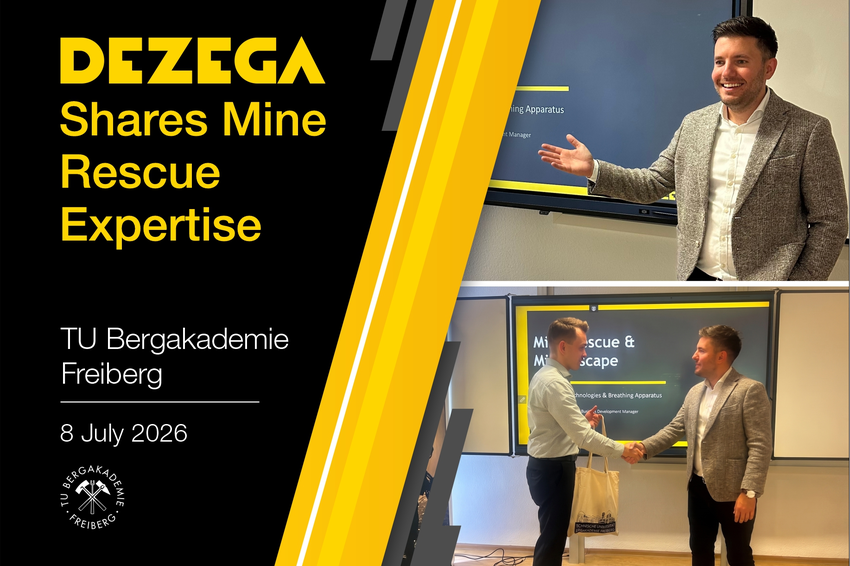
On 7 July 2026, TU Bergakademie Freiberg hosted a guest lecture by Volodymyr Mandrovskyi, Business Development Manager at DEZEGA, who walked students through the full landscape of mine rescue and self-escape technology - from international regulatory frameworks to the engineering decisions behind next-generation closed-circuit breathing apparatus (COBA).
A Global Challenge, Converging Solutions
Countries approach mine rescue differently. The USA relies on MSHA-regulated teams with mandatory deployment requirements. Germany's Grubenwehr tradition brings professionalized brigades and strict EN standards compliance. Australia prioritizes worker self-rescue, supported by refuge chambers. Post-Soviet systems in Ukraine and Kazakhstan bring military-style organization but face modernization challenges. Despite these differences, field feedback from rescue professionals worldwide points in the same direction: longer duration, lower weight, better ergonomics, and smarter digital integration.
Nearly 100 Years of Iteration
DEZEGA's development history spans five generations of closed-circuit apparatus - from the heavy metal PKK-1 of 1931 to the P-70, launched in 2022. Each generation solved specific engineering problems. The P-70 represents the current state of the art: under 14 kg, 4-hour duration, inhalation temperature reduced to 30°C, digital mission monitoring, RFID team tracking, lower total cost of ownership and tool-free maintenance - all in the smallest casing in its class.
User Feedback as Engineering Input
Perhaps the most striking insight from the lecture was how directly field complaints shaped design decisions. Rescuers said breathing was too hot - engineers redesigned the cooling system. The apparatus felt too heavy - composite materials replaced metal casings. This iterative, user-centered approach, backed by 7 years of development and testing across multiple countries, is what separates life-critical equipment from ordinary product development.
The future points toward fully connected rescue teams: biometric monitoring, AI-assisted alerts, integrated communications, and predictive maintenance - transforming the breathing apparatus from a survival tool into an intelligent mission platform.
Want to Learn More?
Interested in the technical specifications and capabilities of the DEZEGA P-70? Visit dezega.com for full product documentation.
Are you a university, mining engineering program, or industry training center looking to bring this lecture to your institution? We welcome educational collaborations and guest speaker requests. Reach out to us at info@dezega.com or via LinkedIn - we'd be glad to continue the conversation.